

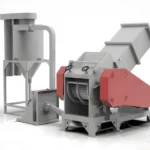
 uPVC Profile & Pipe Granulator
 Granulators for Hard Plastics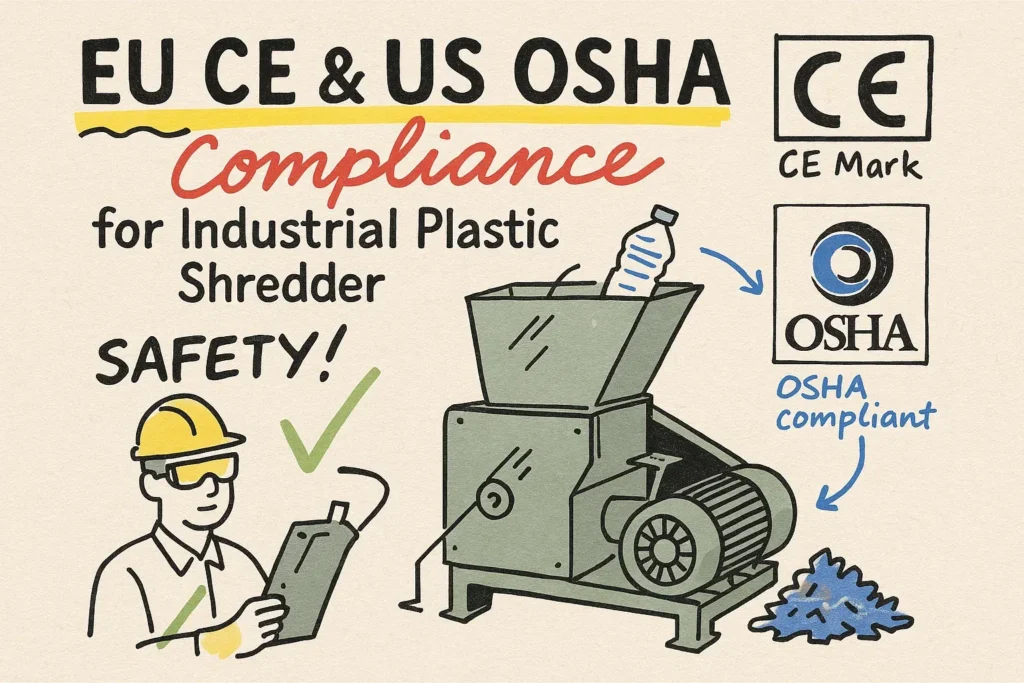
Safety First: A Clear Explanation of EU CE & US OSHA Compliance for Industrial Plastic Shredders
Industrial Plastic Shredders are powerhouses in recycling and waste management, efficiently reducing large volumes of plastic waste to manageable sizes. However, their power also brings inherent risks. Ensuring the safety of these machines requires navigating complex regulatory landscapes, primarily the EU CE marking requirements and the standards of the U.S. Occupational Safety and Health Administration (OSHA).
For buyers, engineers, and technical staff, understanding these compliance frameworks is not just about ticking boxes; it is fundamental to ensuring worker safety, maintaining operational efficiency, avoiding high fines, and securing market access. This article explains what CE marking and OSHA compliance mean for industrial plastic shredders, and helps you make informed decisions and prioritize safety.
How Do Industrial Plastic Shredders Work (and What Are the Risks)?
Before we delve into the regulations, a brief overview of what these machines do and where the dangers lie. An industrial shredder typically consists of:
- Infeed Chute: Where material is introduced.
- Cutting Chamber: Housing for powerful rotating blades or knives mounted on rotors.
- Drive System: Motors and gearboxes that provide torque.
- Discharge System: Where processed material leaves the machine.
- Control Panel: For operation and safety functions.
Common Hazards Include:
- Entanglement/Slicing: Contact with moving blades or rotors.
- Projectiles: Material that is ejected during the shredding process.
- Electrical Shock: From motors, wiring, or control panels.
- Unexpected Startup: During maintenance or while clearing jammed material (Lockout/Tagout is crucial here).
- Noise: High operational noise levels.
- Dust: Potential respiratory risks depending on the material.
Explanation of EU CE-Marking for Shredders
What is CE-Marking?
The CE marking (Conformité Européenne) is a mandatory marking for certain product groups sold within the European Economic Area (EEA) – consisting of the EU countries plus Iceland, Liechtenstein, and Norway – and Turkey. By affixing the CE marking, the manufacturer declares that the product complies with all applicable EU requirements concerning safety, health, and environmental protection. It is essentially a passport to bring the product to the European market.
Why is it Important?
- Market Access: Legally required to sell shredders in the EEA.
- Safety Guarantee: Indicates compliance with fundamental EU safety standards in the design and manufacturing phases.
Important Guidelines for Shredders:
The most critical guideline is the Machinery Directive (2006/42/EC). This directive describes the Essential Health and Safety Requirements (EHSRs) for machines. Depending on the specific features of the shredder, other directives may also apply, such as:
- Low Voltage Directive (LVD) (2014/35/EU): For electrical safety.
- EMC Directive (Electromagnetic Compatibility) (2014/30/EU): To ensure that the equipment does not cause interference with, or is not affected by, other electronic devices.
- ATEX Directive (2014/34/EU): Intended for use in potentially explosive atmospheres.
- Outdoor Noise Emission Directive (2000/14/EC): Intended for outdoor use and where certain noise levels are exceeded.
Manufacturer's Responsibility:
The manufacturer (or its authorized representative in the EU) is solely responsible for:
- Conducting a thorough risk assessment.
- Ensuring that the shredder meets all relevant EVG’s Applicable guidelines.
- Compilation of a Technical File including design drawings, risk assessments, test reports, manuals, etc.
- Drafting and signing a EC Declaration of Conformity (DoC), listing the adhered-to guidelines and standards.
- Applying the CE marking in a visible, legible, and permanent manner on the shredder. op de shredder.
- The provision of a contact point established within the EU on the product or packaging (mandatory since July 2021). What Buyers Should Be Aware Of: The physical presence of the CE marking on the shredder or type plate.
Ask for and verify the
- . Check if it mentions the Machinery Directive (2006/42/EC) and possibly other directives.
- Check if the EvO is signed and contains the manufacturer's and EU contact point information. EC Declaration of Conformity (DoC). Navigating US OSHA Compliance for the Use of Shredders.
- What is OSHA Compliance?.
Navigeren door US OSHA Compliance voor het Gebruik van Shredders
Wat is OSHA Compliance?
OSHA regulations focus on workplace safety in the United States. Unlike the CE marking (product-oriented), OSHA standards dictate how employers must provide a safe working environment and ensure that equipment is operated and maintained safely. Compliance is mandatory for most private sector employers in the U.S.
Why is it Important?
- Employee Protection: Legally required protection against workplace hazards.
- Avoiding Fines: OSHA conducts inspections and can impose significant fines for non-compliance.
- Cost Reduction: Prevents accidents, injuries, and associated costs for workers' compensation insurance and operational downtime.
Important OSHA Standards Applicable to Shredders:
Although OSHA does not have a standard that is *specifically* for “plastic shredders,” various general industrial standards are highly relevant and enforceable (within the US):
- §1910.212 – General Requirements for All Machines: This is of utmost importance. It requires guards for hazards such as the cutting point (where the shredding occurs), entry points (‘nip points’), rotating parts, and flying debris. Guards should, if possible, be permanently mounted, prevent operator access to hazardous areas, and not create new hazards.
- §1910.147 – The Control of Hazardous Energy (Lockout/Tagout – LOTO): Absolutely crucial for shredders. This standard requires employers to establish procedures to de-energize machines and prevent unintended re-energization during service and maintenance. This includes the use of locks or tags on energy-isolating devices.
- §1910.219 – Mechanical Power Transmission Apparatus: Component shielding required for items such as belts, pulleys, chains, and shafts.
- Subsection S – Electrical Safety: Requirements for safe electrical design, wiring, installation, and maintenance.
- §1910.95 – Occupational Exposure to Noise: Requiring hearing protection and a hearing conservation program if sound levels exceed specified limits.
- §1910.144 & §1910.145: Specifications for safety colors and accident prevention signs/labels.
Employer's Responsibility (in the US):
- Ensure that shredders (both new and existing) have adequate machine guarding Develop, implement, and maintain specific.
- Lockout/Tagout procedures for each shredder. Provide comprehensive.
- employee training on hazards, safe operation, guarding, and LOTO procedures. Regularly.
- inspect and maintain the shredder and associated safety equipment. van de shredder en de bijbehorende veiligheidsvoorzieningen.
- Compliance with the General Duty Clause (to provide a workplace free from recognized serious hazards), even if a specific standard does not cover a particular risk.
What Buyers Should Consider (for the US Market):
When purchasing a shredder for use in the US, evaluate how the design facilitates compliance with OSHA *requirements*:
- Is it supplied with robust, well-designed guards that comply with the principles of 1910.212?
- Are there clear, designated points for the installation of Lockout/Tagout devices?
- Is the noise level documented?
- Does the manual provide clear instructions for safe operation, maintenance, and LOTO?
CE vs. OSHA: Understanding the Difference
It is crucial to understand that CE marking and OSHA compliance are not interchangeable. They address different aspects of safety: EU CE Marking US OSHA Compliance
| Feature | Primary Objective | Product safety for market access |
|---|---|---|
| Workplace safety during use & maintenance | Focus | Machine design & construction |
| Focus | Machineontwerp & Constructie | Machine Operation, Maintenance, Employee Training, Environment |
| Responsibility | Manufacturer / EU Authorized Representative | Employer |
| Geography | European Economic Area (EEA) + Turkey | United States |
| Nature | Manufacturer's Declaration (often) | Legal requirement for employers, enforced by inspection |
| Result | Product can be legally sold/branded on the EU market | Safe working environment for employees |
A CE-marked shredder does not automatically mean that the American employer is fully OSHA-compliant after installation. The employer must *still* ensure proper installation, location-specific risk assessment, LOTO procedures, training, etc. However, a well-designed, CE-marked machine often contains safety features that facilitate achieving OSHA compliance.
Why Prioritize Compliance? Tangible Benefits
Investing time and resources in ensuring both CE (if applicable) and OSHA compliance yields significant benefits:
- Protection of Your People: This is the most important benefit. Fewer accidents mean fewer injuries and fatalities.
- Protection of Your Outcome: Avoid costly OSHA fines (in the US), potential lawsuits, increased insurance premiums, and productivity loss due to accidents and downtime.
- Ensuring Market Access: CE marking is essential for selling on the lucrative European market.
- Improving Efficiency & Morale: Safe, well-maintained equipment operates more reliably. Employees who feel safe and valued are generally more productive and have higher morale.
- Improving Reputation: A strong safety performance signals quality and responsibility to customers, employees, and the industry.
Choosing and Implementing a Compliant Shredder: Action-Oriented Steps
Due Diligence for Buyers & Engineers:
- Define Your Market: Are you purchasing for the EU/EER or the US (or both)?
- If Purchase for EU/EER:
- Check the CE Marking: Ensure that it is present on the machine.
- Request the EC Declaration of Conformity (DoC): Examine it carefully. Does it state the correct directives (Machine Directive 2006/42/EC)? Is it signed?
- Ask for the Technical File: Although you may not receive the entire file, the manufacturer should be able to provide summaries or confirmation of its existence.
- Confirm the EU Contact Point.
- If Purchase is for the US:
- Evaluate OSHA-Related Characteristics: Critically evaluate the guarding (fixed, locked?), placement of emergency stops, LOTO provisions, compliance with electrical safety standards, noise data, and the quality of the operating/maintenance manuals.
- Specific Questions: “How does the screening of this shredder comply with OSHA 1910.212?” “Show me the designated LOTO points.”
- Note Essential Safety Features (Supports both CE and OSHA):
- Rugged physical guards (fixed or locked) that prevent access to the cutting chamber and power transmission parts.
- Clearly marked, easily accessible Emergency Stop buttons (E-stops).
- Designated, lockable energy-isolation points (main electrical switch, hydraulic valves, etc.) for LOTO.
- Safety locks on access doors/panels that stop the machine when opened.
- Clear, durable warning labels regarding hazards.
After Purchase: Employer Responsibilities (Focus on OSHA in the US):
- Conduct regular inspections and maintenance to ensure compliance with OSHA standards. Location-specific risk assessment before the installation and use of the shredder.
- Develop, document, and implement machine-specific for each shredder..
- procedures. Establish safe work procedures.
- and set them in stone. Ensure thorough training.
- for operators and maintenance staff on hazards, guarding, safe operation, and LOTO. Implement a Regular inspection and maintenance program for the shredder and its associated safety equipment, and keep documentation of this.
Conclusion: Safety is Non-Negotiable
Navigating through CE marking and OSHA requirements for industrial plastic shredders may seem complex, but it is an essential part of responsible purchase and operation of equipment. CE marking guarantees a basic level of product safety for the EU market, driven by the manufacturer. OSHA compliance ensures continuous workplace safety in the US, driven by the employer.
By understanding these distinct but complementary frameworks, asking the right questions during the purchase process, and implementing robust safety practices in your facility, you can protect your employees, ensure legal compliance, improve operational efficiency, and safeguard your company's reputation. Prioritizing safety is not only good practice – it is good business.
Disclaimer: This article provides general informational guidance and does not constitute legal or specific technical advice. Always refer to the full text of relevant EU directives, OSHA standards, and consult qualified safety professionals or legal advisors for your specific situation.

 English
  Dutch
Dutch  Polish
  Italian
  German
  French
  Spanish