

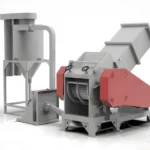
 uPVC Profile & Pipe Granulator
 Granulators for Hard Plastics
End-of-life fishing nets – often referred to as ghost nets – bestaan hoofdzakelijk uit nylon (PA) en polyolefinen (PP/PE). These materials are technically recyclable, provided they are processed correctly. This guide is established from the perspective of kopers en operators en richt zich op hoe en waarom specialized shredders are needed, which configurations work in practice, and how a stable recycling process can be set up.
1. Understand search intent: what is the user actually looking for?
Users searching for “fishing net shredder machine” typically want:
- Evaluate machines for recycling nylon or PP/PE fishing nets
- Understand how tangled, flexible nets can be efficiently shredded
- Verschillende machine-types en capaciteiten vergelijken
- Determine if shredding is suitable as a preparation for further recycling or pelletizing
This is not a purely informational search query, but a technical-commercial decision-making phase. Therefore, the focus in this guide is on practical applicability and industrial reality.
2. Why fishing nets are difficult to shred
Fishing nets behave fundamentally differently than rigid plastics.
Material challenges
- Very high tensile strength (especially with nylon PA6 / PA66)
- Flexible and elastic structure
- High chance of wrapping around the rotor
- Often contaminated with salt, sand, algae and organic material
Standard plastic grinding mills are not suitable for this, as they:
- Stalling due to entanglement
- Cause motor overload
- Cannot achieve a controlled cut
Conclusion: netting requires special designed shredders, no conventional plastic crushers.
3. Suitable shredder types for nylon and PP/PE netting
Single-shaft shredder (most recommended)
Suitable for: nylon, PP and PE netting (dry or pre-washed)
Key features:
- Low rotor speed, high torque
- Hydraulic or electric pusher
- Anti-wrapping cut geometry
- Replaceable screen (usually 20–60 mm)
Why effective:
The low speed prevents heat buildup and limits wrapping, while the high torque tears the material instead of pulling it.
Double-shaft shredder (pre-shredding)
Suitable for: large bundles of netting, ropes and mixed marine waste
Benefits:
- Very robust with irregular feed
- Opens and loosens entangled netting
- Ideal as the first step
Limitations:
- Irregular output size
- Usually requires a second shredding step
4. Recommended industrial processing line
Typical process layout:
- Manual or conveyor belt feed
- Primary shredding (enkelas shredder)
- Output size: 30–50 mm
- Washing and rinsing (strongly recommended)
- Dewatering and drying
- Optional secondary reduction
- Pelletizing or compounding
This setup supports high-quality material recycling, including applications with higher requirements for quality and consistency.
5. Critical technical parameters for machine selection
Rotor and knives
- Large rotor diameter (≥400 mm)
- Intermittent knife pattern
- Wear-resistant tool steel (e.g., SKD11 or equivalent)
Drive
- High-torque reduction gearbox
- Motor power usually 30–75 kW
- Overload protection is essential
Throughput capacity
| Material | Typical capacity |
|---|---|
| Nylon fishing nets | 300–800 kg/u |
| PP / PE netting | 500–1200 kg/u |
Actual capacity depends on net thickness, moisture content, and contamination.
6. Can shredded fishing nets be pelletized?
Yes, provided they are properly prepared.
Nylon (PA) nets
- Thorough washing and drying is required
- Sensitive to moisture (hydrolysis)
- Suitable for single- or twin-screw extrusion
PP / PE nets
- Easier to process
- Less moisture-sensitive
- Widely used in non-food applications
Important: The quality of shredding directly determines pellet quality and economic feasibility.
7. Environmental and regulatory considerations
Recycling fishing nets offers proven benefits:
- Reduction of marine plastic pollution
- Support for circular economy goals
- Recovery of valuable polymers
- Improvement of ESG and sustainability reporting
A correctly chosen shredder is the critical first step.
8. Common mistakes in purchase
- Use of high-speed mills instead of low-speed shredders
- Underestimation of material behavior
- Not accounting for salt and sand
- Purchase of standalone machines without line integration
9. Executive Summary
For recycling of nylon and PP/PE fishing nets is needed:
- A wet grinding and granulating machine is essential for professional recyclers aiming for high-quality end products from contaminated plastic streams. Unlike standard dry grinding, this technology integrates an intensive washing process directly into the cutting chamber. This not only results in efficient size reduction but also produces cleaner 'flakes' ready for further processing right away. specially designed fishing net shredder
- Low speed, high torque
- Proven anti-entanglement technology
- Integration into a complete recycling line
Shredding is not only volume reduction, but determines the stability, scalability and profitability of the entire recycling process.

 English
  Dutch
Dutch  Polish
  Italian
  German
  French
  Spanish