
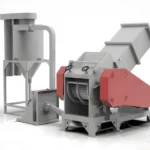
 uPVC Profile & Pipe Granulator
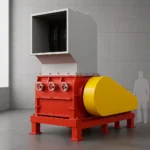 Granulators for Hard Plastics
Grinders vs. Shredders vs. Pelletizing Machines: Understanding the Differences and Synergies
In the world of plastic recycling, grinders, shredders, and pelletizing machines are three common, yet functionally different devices. A clear understanding of their differences and interrelations is crucial for optimizing recycling processes.
Shredder
A shredder is primarily used for the initial reduction of large, bulky, or mixed plastic waste. It generally employs shearing, cutting, or impact methods to produce larger, irregularly shaped pieces. Shredders often serve as preprocessing equipment for grinders, particularly for materials that are too bulky or difficult to feed directly into the hopper of a grinder. The main goal is to reduce the material volume for easier further processing, with less emphasis on the uniformity of the final product.
Grinder
A grinder, as the name suggests, uses rapidly rotating blades to finely cut and break plastics, resulting in smaller, relatively uniform particles or flakes (often referred to as regrind). This regrind can be used directly in production or serve as feedstock for a pelletizing machine.
Pelletizing Machine
A pelletizing machine is generally located at the end of the recycling line. It takes cleaned and reduced (possibly granulated) plastic, melts it, and extrudes it through a die to form strings. These strings are then cut into uniform, marketable plastic granules (pellets) by a granule unit (e.g., water ring, air-cooled, underwater). These pellets have a consistent shape, size, and bulk density, making them easier to store, transport, and use in subsequent plastic molding processes.
Synergies in Recycling Lines
These three types of equipment can work synergistically in a recycling line. A typical process might involve large waste pieces first going through a shredder for coarse reduction, then being transported to a grinder for fine milling. The resulting regrind is then washed and dried before being fed into a pelletizing machine to be melted, extruded, and cut into final plastic granules. Some integrated systems even combine shredder, feed, and extrusion (pelletizing) functions in a single step.
The optimal configuration of the recycling line (e.g., Shredder → Grinder → Pelletizing Machine vs. Grinder → Pelletizing Machine) is strongly dependent on the form and volume of the incoming material, as well as the specifications required for the final product. There is no one “best” order. The choice of equipment and the sequence of operations is a strategic decision based on material characteristics and processing goals, crucial for engineers designing recycling lines.
Consequences of Misunderstanding Equipment Roles
Confusion regarding the various roles of shredders, granulators, and pelletizing machines can lead to inefficient processing, increased energy consumption, and a lower quality of recycled materials, ultimately affecting the return on investment. For instance, using a granulator to process very large or tough materials that are more suitable for a shredder will result in excessive wear of blades and screens, frequent clogs, and motor overload. Similarly, it is unrealistic to expect that granulated waste material will have the same physical properties as pelletized granules. Clearly distinguishing the functions of this equipment helps buyers make informed investment decisions and enables engineers to design efficient recycling systems.

 English
  Dutch
Dutch  Polish
  Italian
  German
  French
  Spanish