

 uPVC Profile & Pipe Granulator
 Granulators for Hard Plastics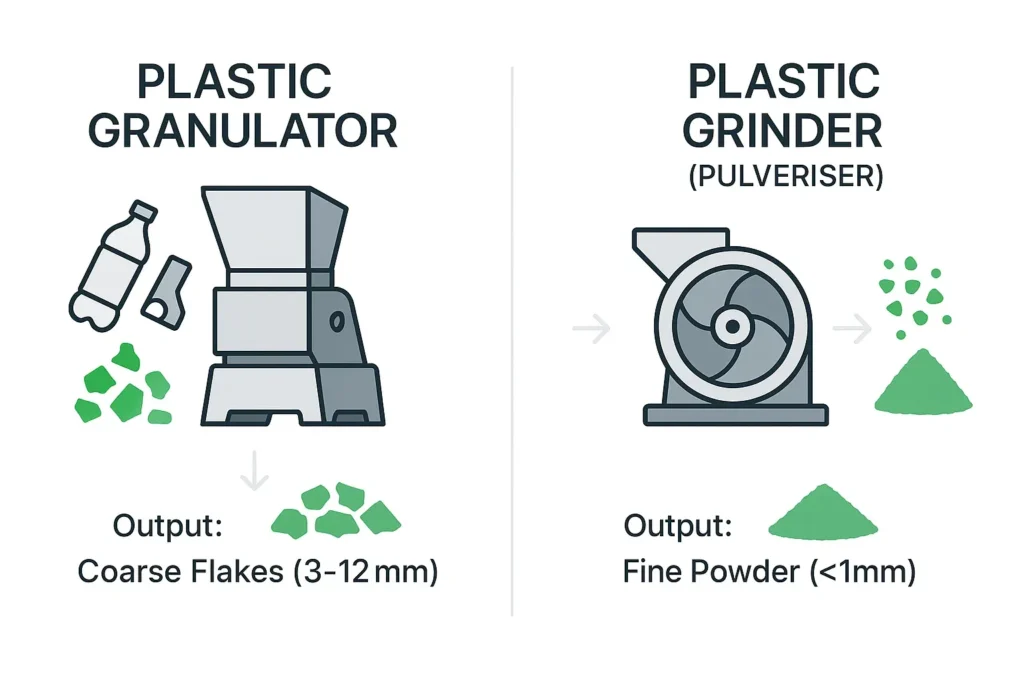
The choice between a plastic granulator versus a grinder (or pulverizer) is a critical decision in plastic processing that has direct implications for efficiency, energy costs, and the quality of your final product. While both machines reduce material size, their operating principles, output, and applications are fundamentally different. A wrong choice can lead to unnecessary energy consumption, suboptimal material quality, and production downtime. This guide is specifically intended for engineers, production managers, and buyers in the recycling and plastic industries. We analyze the technical differences so that you can make a well-considered decision that perfectly aligns with your process requirements. At [Company Name], we help our customers daily with selecting the right equipment. What is a Plastic Granulator?.
A plastic granulator is a machine designed to cut larger pieces of plastic, such as waste products, bottles, profiles, or films, into small, uniform particles. These particles are referred to as "regrind" or "flakes" and are directly suitable for reuse in production processes. At its core, a wet grinding and granulating machine (also known as a wet granulator or washing granulator) is a heavy-duty industrial reducer designed to process large quantities of water during the cutting process. It is specifically developed for the plastic recycling sector to process contaminated post-consumer or post-industrial plastics. helpen we onze klanten dagelijks met het selecteren van de juiste apparatuur.
Wat is een Kunststofgranulator?
A wet grinding and granulating machine is essential for professional recyclers aiming for high-quality end products from contaminated plastic streams. Unlike standard dry grinding, this technology integrates an intensive washing process directly into the cutting chamber. This not only results in efficient size reduction but also produces cleaner 'flakes' ready for further processing right away. kunststofgranulator is een machine die is ontworpen om grotere stukken kunststof, zoals productafval, flessen, profielen of folies, te versnijden tot kleine, uniforme deeltjes. Deze deeltjes worden “regrind” of “flakes” genoemd en zijn direct geschikt voor hergebruik in productieprocessen.
Principles of a Granulator:
- Mechanism: A granulator operates like a robust scissor. Rotating blades on a rotor cut the material against fixed, stationary blades within a cutting chamber.
- Output Control: A perforated sieve under the cutting chamber determines the maximum size of the final product. The material circulates in the chamber until it is small enough to fall through the sieve holes.
- Final Product: The output is a relatively uniform granulate (flakes), typically between 3 mm and 12 mm in size, with an irregular, angular shape.
Typical Applications:
Granulators are the workhorses for volume reduction and the creation of reusable material. They are primarily used for:
- Direct processing of production waste (e.g., sprues, rejected parts) for reuse in injection molding or extrusion processes.
- Material reduction in a large-scale recycling line, prior to it being sent to a washing facility.
- Volume reduction of logs and bulky waste to lower transportation and storage costs.
Standard Plastic Granulators
For the efficient reduction of plastic waste into high-quality regrind. Our granulators are designed for sustainability and easy maintenance, ideal for direct integration into your production line.
View Models & SpecificationsWhat is a Plastic Pulverizer (Grinder)?
Although the term ‘grinder’ is sometimes used, the technically correct name is pulverizer or micronizer. This machine serves a completely different purpose: it Grind plastic (often pre-granulated) into a very fine powder. Principles of a Pulverizer:.
Instead of cutting, a pulverizer works through impact and friction. A commonly used type is the disk mill, where the material is crushed between one or two very rapidly rotating, toothed disks.
- Mechanism: The fineness of the powder is precisely controlled by the distance between the disks, the disk design, and often an air classification system that separates the final product.
- Output Control: The output is a fine, free-flowing powder, generally smaller than 1 mm (1000 microns), often specified in 'mesh' or microns (e.g., 300-800 microns).
- Final Product: Pulverizers are specialized machines required when the final product needs to be a powder. The main applications include:.
Typical Applications:
Production of plastic powder for
- rotomolding (a process where powder is melted in a mold). (rotomolding), een proces waarbij poeder in een mal wordt gesmolten.
- The creation of fine additives or fillers for compounding processes.
- Production of masterbatches and PVC compounds for pipes and profiles.
PVC Pulverizer / Micronizer
Transform plastic granulate into fine, uniform powder with our advanced pulverizers. Ideal for rotational molding, compounding, and other applications requiring precise particle size.
Discover Our SystemsGranulator vs. Grinder: The Direct Comparison
The following table highlights the main technical and operational differences.
| Feature | Kunststofgranulator | Plastic Pulverizer (Grinder) |
|---|---|---|
| Primary Function | Cutting into flakes/regrind | Grinding into fine powder |
| Final Product | Chips/Flakes (approx. 3mm – 12mm) | Powder (typically < 1mm / 1000 microns) |
| Principle of Operation | Cutting/Shearing (Slicing) | Impact/Friction/Crushing (Shredders/hammers) |
| Typical Feed Material | Large plastic parts, waste, film | Pre-granulated material (flakes) |
| Energy Consumption | Average | High (requires much energy to make powder) |
| Application Output | Direct reuse (injection molding, extrusion) | Specialized processes (rotational molding, compounding) |
Decision Guide for Professionals
Use this checklist to quickly identify the right machine:
When should you choose a GRANULATOR?
- Your goal is: To reduce the volume of waste and make it directly reusable in your existing machines (injection molding, extrusion).
- Your input is: Large, bulky parts, sprues, bottles, or thick film.
- Uniform particles of a few millimeters in size (regrind). When is a PULVERIZER (GRINDER) the right choice?.
To produce a fine powder as the final product for a specific process.
- Your goal is: Generally already reduced material (granulate).
- Your input is: A powder with a precisely defined, very fine particle size (measured in microns or mesh).
- Uniform particles of a few millimeters in size (regrind). The Two-Step Solution: Granulator + Pulverizer.
In many cases, these machines work together. A granulator performs the first, coarse reduction. The resulting granulate is then fed into a pulverizer for the fine grinding to powder. This is the most energy-efficient method to convert large waste into fine powder.
Conclusion: The Right Machine for the Right Task.
Conclusie: De Juiste Machine voor de Juiste Taak
The distinction between a plastic granulator and a grinder (pulverizer) is clear: the granulator cuts material into reusable flakes, while the grinder grinds it into fine powder for specialized applications. The choice depends entirely on your desired end product and downstream process. By selecting the right technology, you not only optimize your material flow but also reduce your operational costs and increase the value of your recycled materials. A granulator is the start of many recycling cycles; a grinder is the key to high-quality powder applications. Determine the difference between a plastic granulator and grinder? Our guide helps you choose the right machine for flakes or fine powder. Plastic Granulator vs Grinder: The Guide for Professionals | Rumtoo plastic granulator versus grinder the differences and best applications in the industry.
Door de juiste technologie te selecteren, optimaliseert u niet alleen uw materiaalstroom, maar verlaagt u ook uw operationele kosten en verhoogt u de waarde van uw gerecyclede materialen. Een granulator is de start van vele recyclingcycli; een pulverisator is de sleutel tot hoogwaardige poedertoepassingen.

 English
  Dutch
Dutch  Polish
  Italian
  German
  French
  Spanish