

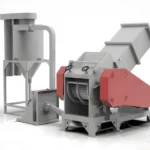
 uPVC Profile & Pipe Granulator
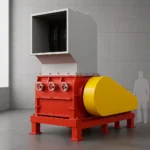 Granulators for Hard Plastics
What is a swing arm shredder
A swing arm shredder is a single shaft shredder with low speed and high torque, equipped with a hydraulic swing arm duwer. The machine reduces bulky or difficult-to-feed material to a controlled outlet size before it proceeds to the next steps such as granulation, washing, or pelletizing.
The swing arm duwer is the main difference. This moves in an arc and presses the material into the rotor. This design avoids linear guide rails. It helps to reduce the risk of blocking when processing dirty bales, mixed waste, and long fiber streams.
For the models and specifications of the WT swing arm shredder series, see the equipment page.
Principle of Operation
A single shaft shredder achieves reduction through controlled sliding.
- Input
Material comes into the hopper and falls by gravity into the cutting chamber.
- Positive material control
The hydraulic swing arm duwer presses the input towards the rotor. This can be in continuous mode or in cycle mode. This keeps the cutting zone filled and stable.
- Cutting and sizing
Rotor blades cut against fixed blades. The material is reduced step by step. A screen determines the maximum outlet size. Material that does not pass through the screen remains in the chamber for additional cuts.
Design notes for the WT series on the equipment page include a toothless hydraulic drive, swing arm input, and a universal V rotor concept that supports a stable cutting gap for consistent capacity and lower energy consumption.
Important components in selection
Focus on these components when comparing machines or quotes.
- Hydraulic drive system
Hydraulic drive withstands shock loads and contamination well. It also supports start, stop, and reverse under full load. This is important in RDF and dirty bale applications.
- Swing arm duwer
The duwer rotates instead of sliding. This reduces sensitivity to dirt and fines. It also reduces the risk of clogs caused by strips or particles that get caught in linear guides.
- Rotor and knives
The rotor geometry determines the bite and cutting rhythm. Blade configuration affects output consistency and energy requirement. Reversible square blades extend the service life. The actual lifespan depends on abrasives, contamination, and operating settings.
- Sieve
The screen opening determines the oversize of the product. The WT series supports screen openings from 40 mm to 100 mm on the product page. Use a larger screen for higher throughput and lower specific energy. Use a smaller screen when you need a tighter sizing for downstream equipment.
- Control System
A Siemens PLC with a touch panel supports clear operation and stable production. It also helps with line integration with conveyors and secondary reduction.
Applications and materials
A swing arm shredder is best suited when the material poses a challenge for stable feeding.
Geperste balen
The WT series is designed to process full bales, such as bales with PET bottles and bales with film. The swing arm duwer keeps the material in motion towards the rotor.
Woven bags and big bags
These streams have a high tensile strength. They also cause bridging and winding in many machines. A strong duwer and low speed cutting reduce the risk.
Landbouwfolie
Agricultural film often contains sand and soil. Wear increases accordingly. Use robust settings, good contamination control, and a suitable screen.
RDF and SRF production
RDF and SRF lines have become a subject of much interest, as they convert mixed combustible waste into a standardized fuel fraction. This input often contains plastics, paper, textiles, light wood, and fines. It also often contains dirt and non-combustible contamination.
A swing arm shredder aids in RDF and SRF preparation for three reasons.
- It keeps mixed and dirty feedstock in motion.
- It reduces bridging in the hopper.
- It supports controlled sizing through the screen, allowing you to feed a second shredder or separator more reliably.
The WT series designates RDF and SRF as target streams on the equipment page.
Six parameters that determine performance
Provide these inputs before requesting a quote. They also help prevent underdimensioning.
- Material list
Describe each stream and its percentage share. Include plastic type, paper, textile, wood, and fines if present.
- Bulk density and shape
Indicate whether you feed loose material, bales, rolls, or bulky parts.
- Maximum piece size
State the largest piece size and thickness. This directly relates to requirements for the hopper and cutting chamber.
- Contamination
Name metal risk, stones, sand, and moisture. Add an estimated contamination level if possible.
- Target output size
State your target oversize and the desired screen opening. If unsure, start with 40 mm to 100 mm and refine after testing.
- Line target
Indicate whether you prioritize throughput, stable operation, or tighter sizing. You cannot maximize all three.
The WT series includes a model table with rotor diameter, feed opening, motor power, rotor speed, number of blades, screen range, and reference capacity. Use this for an initial shortlist, and confirm with a material test.
Integration of a swing arm shredder into a recycling line
Most installations use shreds as the first step for volume reduction.
- Upstream control
Use a magnet and metal detector where possible. Remove large metals and stones before the material enters the shredder. This protects the blades and reduces downtime.
- Downstream strategy
Direct the shredder output to a secondary granulator, a crusher, a washer, or a separator, depending on your goal.
Common follow-up steps for RDF and SRF are screening, air separation, metal removal, and secondary reduction. Stable, consistent feed increases separation efficiency.
Frequently Asked Questions
- Why does capacity vary so strongly
Capacity depends on material type, moisture, contamination, and screen size. The WT series also notes that actual capacity depends on material properties and configuration.
- How do I choose the screen size
Choose based on downstream requirements. Use a larger opening for higher throughput and lower energy consumption. Use a smaller opening for tighter size control and better separation. Validate with tests.
- How often do I replace blades
The lifespan of blades depends on wear, contamination, and operational strategy. Reversible blades extend the usable lifespan. Low-speed shredding typically improves service life compared to high-speed cutting, but maintenance planning remains crucial.
Next step
If you want to shred RDF SRF, bales, or contaminated films, start with your target overcapacity and your contamination profile. Then, make a shortlist of WT models based on feed opening and capacity. Conduct a test to confirm product quality and energy requirements.

 English
  Dutch
Dutch  Polish
  Italian
  German
  French
  Spanish